Research
Everything on this page is continuum mechanics applied to something particular: the arch of a human foot, a flowing soap film, a bowl of cereal, a seagrass meadow, a tidal channel. The problems are chosen for the question rather than the field, and each is pursued until there is a model that could be proved wrong and the physics underneath it is laid bare.
Sometimes the model becomes a device. The oscillating hydrofoil began as a question about the lift a foil keeps after the flow separates from its leading edge; under an ARPA-E award it became prototypes generating power in the Cape Cod Canal. The pages below are written for anyone who is curious; the scientific detail is in the publications linked from each.
Feet and fins
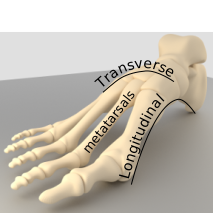
Why do our feet look the way they do? Believe it or not, some of us do ask ourselves this question.
Publications
Stiffness of the human foot and evolution of the transverse arch
Venkadesan, Yawar, Eng, Dias, Singh, Tommasini, Haims, Bandi and Mandre. Nature 579, 97-100 (2020).PDF Publisher link
Abstract: The stiff human foot enables an efficient push-off when walking or running, and was critical for the evolution of bipedalism. The uniquely arched morphology of the human midfoot is thought to stiffen it, whereas other primates have flat feet that bend severely in the midfoot. However, the relationship between midfoot geometry and stiffness remains debated in foot biomechanics, podiatry and palaeontology. These debates centre on the medial longitudinal arch and have not considered whether stiffness is affected by the second, transverse tarsal arch of the human foot. … (read more)
Dynamics and stability of running on rough terrains
Dhawale, Mandre and Venkadesan. R. Soc. Open Sci. 6: 181729 (2019).PDF Publisher link
Abstract: Stability of running on rough terrain depends on the propagation of perturbations due to the ground. We consider stability within the sagittal plane and model the dynamics of running as a two-dimensional body with alternating aerial and stance phases. Stance is modelled as a passive, impulsive collision followed by an active, impulsive push-off that compensates for collisional losses. Such a runner has infinitely many strategies to maintain periodic gaits on flat ground. … (read more)
Curvature-induced stiffening of fish fin
Nguyen, Yu, Bandi, Venkadesan and Mandre. J. R. Soc. Interface. 14: 20170247.PDF Publisher link
Abstract: How fish modulate their fin stiffness during locomotive manoeuvres remains unknown. We show that changing the fin’s curvature modulates its stiffness. Modelling the fin as bendable bony rays held together by a membrane, we deduce that fin curvature is manifested as a misalignment of the principal bending axes between neighbouring rays. An external force causes neighbouring rays to bend and splay apart, and thus stretches the membrane. This coupling between bending the rays and stretching the membrane underlies the increase in stiffness. … (read more)
In the press
- The Rest Is Science · Why Feet Are Weirder Than You Think
- Lower Extremity Review · Overlooked arch in the foot is key to its evolution and function
- Physics World · Transverse arch puts a spring in your step, biomechanics study reveals
- Nature India · How the arches on our feet evolved
- Archaeology Magazine · Curved feet may have helped hominins walk upright
-
BBC Radio Scotland ·
Newsdrive
- National Geographic · Why human feet evolved arches — and what happens if you lack them
- archedfoot.warwick.ac.uk · The arched foot — a companion site to the Nature paper
- Nature · Ahead of the curve in the evolution of human feet
- Human Frontier Science Program · Curvature stiffens fish fins
- ScienceDaily · Like a slice of pizza, a curvature could give fish fins their strength
Oscillating hydrofoil for hydrokinetic power
Movie 1: Computational fluid dynamics simulation of an oscillating hydrofoil.
Between 2013 and 2017 I led an ARPA-E programme at Brown University that took an oscillating hydrofoil for tidal and river power from the equations to 1 kW and 2 kW devices tested in the Taunton River and the Cape Cod Canal, which took it from technology readiness level 1 to 6. The physics is the lift a foil keeps after the flow separates from its leading edge, a cousin of the vortex-driven waving of marine grass; the engineering is a machine that turns it into power under both directions of the tide.
Read more about Oscillating hydrofoil for hydrokinetic power
Publications
Energy harvesting performance and flow structure of an oscillating hydrofoil with finite span
Kim, Strom, Mandre, Breuer. J. Fluids Struct. 70, 314-326 (2017).PDF Publisher link
Abstract: The energy harvesting performance and resulting flow structures of a hydrofoil oscillating in pitch and heave are studied experimentally in a water flume. The shape of a hydrofoil cross-section is shown to have negligible influence on the power generation for the geometries tested. It is found that contribution to efficiency from heaving motion increases with reduced frequency at optimal pitching amplitude. However, contribution to efficiency from pitching motion decreases with reduced frequency because the development of a leading-edge vortex during the stroke is delayed at the high reduced frequency. … (read more)
Confinement effects on energy harvesting by a heaving and pitching hydrofoil
Su, Miller, Mandre and Breuer. J. Fluids Struct. 84, 233-242 (2019).PDF Publisher link
Abstract: Wall confinement effects on the energy harvesting performance by a flapping hydrofoil (aspect ratio 4.5) have been investigated in a circulating water flume at a Reynolds number of 50,000. Measurements of hydrodynamic forces are taken for three different confinement configurations (unconfined, one-wall and two-wall confinement) and a series of confinement levels for each configuration. Compared with the unconfined situation, a significant improvement of efficiency performance is obtained for strong two-wall confinement due to the enhancement of the hydrodynamic forces, while only a modest increase is observed in the one-wall confinement configuration. … (read more)
In the press
- Rhode Island Public Radio · Capturing a river's energy with wings
- The Providence Journal · On the Taunton river, Brown researchers pursuing future of tidal energy
- The Providence Journal · Brown University engineers design unique device that could harness power of tides
- News from Brown · A better water wing to harvest tidal energy
Fluid mechanical kinematic optimization
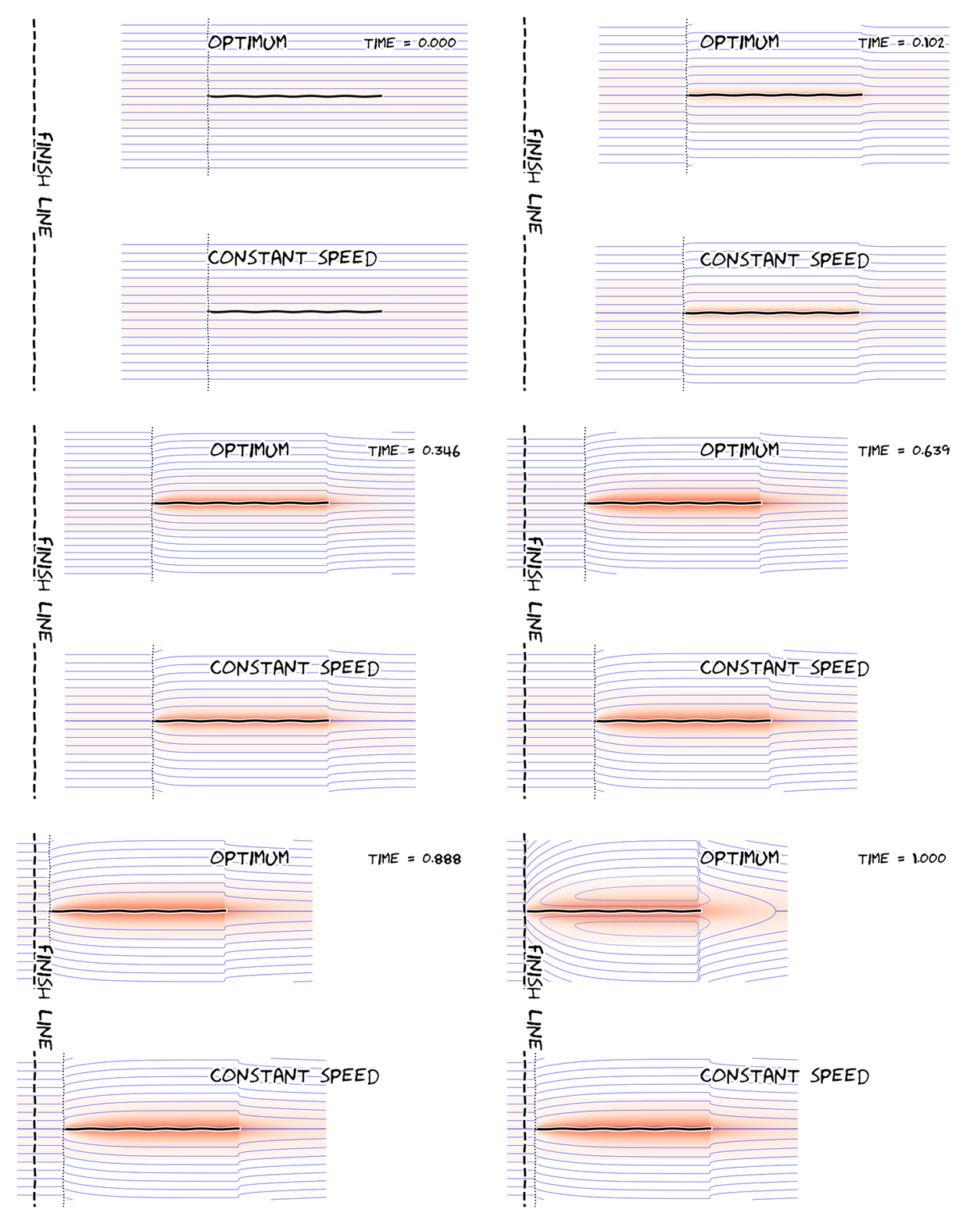
The fastest flat-plate under fixed energy budget
In 1696, Johann Bernoulli posed a challenge called the brachistochrone problem, which kickstarted the field of calculus of variations. Here is simplest fluid mechanical version of the brachistochcrone problem.
Read more about Fluid mechanical kinematic optimization
Publications
Brachistochronous motion of a flat plate parallel to its surface immersed in a fluid
Mandre. J. Fluid Mech., 939 A27 (2022).PDF Publisher link
Abstract: We determine the globally minimum time 𝑇 needed to translate a thin submerged flat plate a given distance parallel to its surface within a work budget. The Reynolds number for the flow is assumed to be large so that the drag on the plate arises from skin friction in a thin viscous boundary layer. The minimum is determined computationally using a steepest descent, where an adjoint formulation is used to compute the gradients. … (read more)
Work-minimizing kinematics for small displacement of an infinitely long cylinder
Mandre. J. Fluid Mech. 893 R4 (2020).PDF Publisher link
Abstract: We consider the time-dependent speed of an infinitely long cylinder that minimizes the net work done on the surrounding fluid to travel a given distance perpendicular to its axis in a fixed amount of time. The flow that develops is two-dimensional. An analytical solution is possible using calculus of variations for the case that the distance travelled and the viscous boundary layer thickness that develops are much smaller than the circle radius. … (read more)
Flowing soap films

Measuring the Marangoni elasticity of soap films.
Ever wondered why you can blow bubbles from soap solution in water, but not from water itself or from a solution of sugar or salt?
Read more about Flowing soap films
Publications
Surface tension of flowing soap films
Sane, Mandre and Kim. J. Fluid Mech. 841, R2 (2018).PDF Publisher link
Abstract: The surface tension of flowing soap films is measured with respect to the film thickness and the concentration of soap solution. We perform this measurement by measuring the curvature of the nylon wires that bound the soap film channel and use the measured curvature to parametrize the relation between the surface tension and the tension of the wire. We find that the surface tension of our soap films increases when the film is relatively thin or is made of soap solution of low concentration; otherwise, it approaches an asymptotic value of 30 mN/m. … (read more)
Marangoni elasticity of flowing soap films
Kim and Mandre. Phys. Rev. Fluids 2, 082001(R) (2017).PDF Publisher link
Abstract: We measure the Marangoni elasticity of a flowing soap film to be 22 mN/m irrespective of its width, thickness, flow speed, or the bulk soap concentration. We perform this measurement by generating an oblique shock in the soap film and measuring the shock angle, flow speed, and thickness. We postulate that the elasticity is constant because the film surface is crowded with soap molecules. Our method allows nondestructive measurement of flowing soap film elasticity and the value 22 mN/m is likely applicable to other similarly constructed flowing soap films. … (read more)
Axisymmetric spreading of surfactant from a point source
Mandre. J. Fluid Mech. 832, 777-792 (2017).PDF Publisher link
Abstract: Guided by computation, we theoretically calculate the steady flow driven by the Marangoni stress due to a surfactant introduced on a fluid interface at a constant rate. Two separate extreme cases, where the surfactant dynamics is dominated by the adsorbed phase or the dissolved phase, are considered. We focus on the case where the size of the surfactant source is much smaller than the size of the fluid domain, and the resulting Marangoni stress overwhelms the viscous forces so that the flow is strongest in a boundary layer close to the interface. … (read more)
Hydrodynamic signatures of stationary Marangoni-driven surfactant transport
Bandi, Akella, Singh, Singh and Mandre. Phys. Rev. Lett. 119, 264501 (2017).PDF Publisher link
Abstract: We experimentally study steady Marangoni-driven surfactant transport on the interface of a deep water layer. Using hydrodynamic measurements, and without using any knowledge of the surfactant physicochemical properties, we show that sodium dodecyl sulphate and Tergitol 15-S-9 introduced in low concentrations result in a flow driven by adsorbed surfactant. At higher surfactant concentration, the flow is dominated by the dissolved surfactant. Using camphoric acid, whose properties are a priori unknown, we demonstrate this method’s efficacy by showing its spreading is adsorption dominated. … (read more)
Waving marine grass
I bet you have seen gusts of wind exciting synchronized waves on the surface of tall grass field just like observed on the beach.
Read more about Waving marine grass
Publications
Linear stability analysis for monami in a submerged seagrass bed
Singh, Bandi, Mahadevan and Mandre. J. Fluid Mech. 786, R1 (2016).PDF Publisher link
Abstract: The onset of monami – the synchronous waving of seagrass beds driven by a steady flow – is modelled as a linear instability of the flow. Unlike previous works, our model considers the drag exerted by the grass in establishing the steady flow profile, and in damping out perturbations to it. We find two distinct modes of instability, which we label modes 1 and 2. Mode 1 is closely related to Kelvin–Helmholtz instability modified by vegetation drag, whereas mode 2 is unrelated to Kelvin–Helmholtz instability and arises from an interaction between the flow in the vegetated and unvegetated layers. … (read more)
Cheerios effect
Pour milk into a bowl, drop in some Cheerios (the breakfast cereal), and notice how they clump together. This attraction is mediated by gravity and surface tension. Each cheerio makes a little depression in the milk-air interface, and the neighbouring one just falls into it.
Read more about Cheerios effect
Publications
Capillary interactions between nearby interfacial objects
He, Nguyen and Mandre. Europhys. Lett. 102, 38001 (2013).PDF Publisher link
Abstract: We develop a general method to study the capillary interactions between objects of arbitrary shape which float close to each other on an interface, a regime in which multipole expansion is not useful. The force is represented as a power series in the small distance between the objects, of which the leading order is finite. For objects with size a much larger than the capillary length lc, the force scales as (a/lc)1/2 and the prefactor depends on the mean radius of curvature R at the closest points. … (read more)