Feet and fins
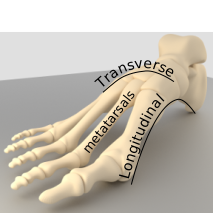
Arches in the foot (credit: M. Venkadesan, Yale University)
Why do our feet look the way they do? Believe it or not, some of us do ask ourselves this question.
While feet in animals and fins in fish are generally considered separately, they are related in two ways. Firstly, feet evolved from fins (between 300 and 400 million years ago). Thus, their genetic and developmental pathways are related. Secondly, feet and fins perform a similar function. They both push on their environment (land for feet, water for fins) to generate propulsive force for locomotion. What can these similarities tell us about the way feet and fins are structured?
A lot, actually, and we do not have the complete story. Firstly, human feet are arched. These arches, shown in the adjoining picture, are the hallmark of its structure, and are considered to have evolved alongside bipedalism. In a recent work, we showed that it is the transverse arch that enables the foot to push on the ground without deforming. The transverse curvature of the foot makes it stiffer analogoug to how a slice of pizza droops less when curved along the crust. Our work has overturned a century old theory that focussed on the longitudinal arch of the foot to underlie its stiffness.
Fish also curve their fins during propulsion, which stiffens them under hydrodynamic loads. Remarkably, the curvature of the fins need not be visible externally but could be embedded within its skeletal structure. Read all about it in this publication.
Also in this series, read about our abstraction of running. Just as walking is composed of a sequence of swinging on one foot like an inverted pendulum, and catching oneselves by landing on the other foot, running is a sequence of bouncing along the ground. Think about it this way the next time you go for a run.
A better understanding of the structure of these propulsive appendages has many applications. It will help us define flatfootedness in a clinical setting, perhaps even come up with more effective interventions for those with symptomatic ones. It will also help us translate the biological principles in robotic bio-inspired mimics and in prostheses.
Publications
Stiffness of the human foot and evolution of the transverse arch
Venkadesan, Yawar, Eng, Dias, Singh, Tommasini, Haims, Bandi and Mandre. Nature 579, 97-100 (2020).PDF Publisher link
Abstract: The stiff human foot enables an efficient push-off when walking or running, and was critical for the evolution of bipedalism. The uniquely arched morphology of the human midfoot is thought to stiffen it, whereas other primates have flat feet that bend severely in the midfoot. However, the relationship between midfoot geometry and stiffness remains debated in foot biomechanics, podiatry and palaeontology. These debates centre on the medial longitudinal arch and have not considered whether stiffness is affected by the second, transverse tarsal arch of the human foot. … (read more)
Dynamics and stability of running on rough terrains
Dhawale, Mandre and Venkadesan. R. Soc. Open Sci. 6: 181729 (2019).PDF Publisher link
Abstract: Stability of running on rough terrain depends on the propagation of perturbations due to the ground. We consider stability within the sagittal plane and model the dynamics of running as a two-dimensional body with alternating aerial and stance phases. Stance is modelled as a passive, impulsive collision followed by an active, impulsive push-off that compensates for collisional losses. Such a runner has infinitely many strategies to maintain periodic gaits on flat ground. … (read more)
Curvature-induced stiffening of fish fin
Nguyen, Yu, Bandi, Venkadesan and Mandre. J. R. Soc. Interface. 14: 20170247.PDF Publisher link
Abstract: How fish modulate their fin stiffness during locomotive manoeuvres remains unknown. We show that changing the fin’s curvature modulates its stiffness. Modelling the fin as bendable bony rays held together by a membrane, we deduce that fin curvature is manifested as a misalignment of the principal bending axes between neighbouring rays. An external force causes neighbouring rays to bend and splay apart, and thus stretches the membrane. This coupling between bending the rays and stretching the membrane underlies the increase in stiffness. … (read more)
In the press
- The Rest Is Science · Why Feet Are Weirder Than You Think
- Lower Extremity Review · Overlooked arch in the foot is key to its evolution and function
- Physics World · Transverse arch puts a spring in your step, biomechanics study reveals
- Nature India · How the arches on our feet evolved
- Archaeology Magazine · Curved feet may have helped hominins walk upright
-
BBC Radio Scotland ·
Newsdrive
- National Geographic · Why human feet evolved arches — and what happens if you lack them
- archedfoot.warwick.ac.uk · The arched foot — a companion site to the Nature paper
- Nature · Ahead of the curve in the evolution of human feet
- Human Frontier Science Program · Curvature stiffens fish fins
- ScienceDaily · Like a slice of pizza, a curvature could give fish fins their strength
Read more at archedfoot.warwick.ac.uk.
Other things we work on
- Oscillating hydrofoil for hydrokinetic power
- Fluid mechanical kinematic optimization
- Flowing soap films
- Waving marine grass
- Cheerios effect
Interested in working on this? Funding schemes I can supervise or host are listed with their deadlines, and the people who have worked on it are here.