
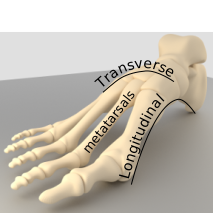
Why do our feet look the way they do? Why can you blow bubbles from soapy water, but not from water itself? Why does breakfast cereal clump together in the bowl?
I am an applied mathematician, an engineer and a scientist, and questions like these are what I work on. The thread running through them is continuum mechanics, i.e. how fluids and solids deform and interact, and how that sets the shapes and the motions of living and engineered things.
At the moment that means the mechanics of feet and fins, flowing soap films, the Cheerios effect, the cheapest way to move something through a fluid, and waving marine grass and what it tells us about wind and tidal energy. There is more on the research pages, and the publications are browsable by topic.
Not all of it stays on paper. Between 2013 and 2017 I led an ARPA-E programme at Brown University that took an oscillating hydrofoil for tidal and river power from the concept to 1 kW and 2 kW prototypes tested in the Taunton River and the Cape Cod Canal. I work with companies on the same footing through Cambridge Enterprise’s Consultancy Services, which handles the contract and the insurance. The work includes consulting and technical due diligence, collaborative research, and short courses for engineering teams. A paragraph on the problem, sent to the address below, is enough to start.
If you would rather listen than read, Hannah Fry and Michael Stevens spent an episode of The Rest Is Science on the feet work; the rest of the press coverage is collected too.
I supervise PhD students, postdocs and summer interns, and I am glad to act as the institutional host for someone applying for their own funding. The schemes I can support are listed with their deadlines. My lecture notes on fluid dynamics, dimensional analysis, interfaces and flow instability are free for anyone to read.
Before Cambridge I was at the Warwick Mathematics Institute, and before that at Brown University and at Harvard. My PhD is in mathematics from the University of British Columbia, under the able guidance of Neil J. Balmforth, and my first degree is in mechanical engineering from IIT Bombay. My CV has the full record.
Since 2024, I have been writing a log about hypertrophic cardiomyopathy. This writing was inspired by my experience with the disease, which has fluid-structure interaction underlying it. The log uses my experiences with the disease to comment about the cardiovascular mechanics (and a few other surrounding topics) in this disease.
Contact
| Trumpington Street, Cambridge CB2 1PZ | |
| sdm63 (at) cam (dot) ac (dot) uk | |
| +44 (0)1223 332605 | |
| Curriculum vitae (PDF) |